
I’m Josh, a freshly-minted particle-physics PhD pivoting to quant research. This blog is my open notebook: experiments, post-mortems, and the occasional scar-tissue story from trading crypto at 5 × leverage.
My finance origin story
My first interest in finance was around 2014 when I was visiting someone who happened to buy a couple of bitcoin close to its inception and had forgotten about it until seeing what the price now was. We sat together at his desk and bought and sold over a few hours and doubled the amount - “Well that’s awesome”.

A couple of years passed and I was now starting university and thanks to my student loan had some disposable income. I put in 10, 20, 40 quid (an amount I could comfortably lose) every so often and started to trade ETH, XRP and some smaller cap coins. I got a little obsessed and probably spent more time doing this than I should have, but in staring at charts all day I started to get a feel for the way prices moved and managed to make some money. This was going well and then I saw the powerful and dangerous word “leverage”. A few months of rapidly oscillating between 300% gains and 90% losses went by before I lost the small amount I’d put in and decided to give it a break.
Lesson — Use stop-losses
Take-away: Don’t get cocky; hard stops preserve capital.
In 2018 I began dabbling in tradfi. In particular, warrants. Funnily enough, my first experience with them was a Micron call - a chip company that makes a large quantity of the world’s memory. A few days after my first purchase Donald Trump announced $50 billion of tariffs on Chinese goods, as luck would have it, many of Micron’s foundrys are in China. I found it particularly frustrating trying to figure out how the warrants were priced. There was a particular occasion when I had bought calls on a company days before its earnings report, the company beat expectations, yet my calls lost value. So I phoned Vontobel Bank who had written the warrants, and somehow ended up getting through to a very confused trader at one of their desks. He seemed so bemused by the situation that he spent the next 15 minutes explaining the Black-Scholes equation and how each company has their proprietary adjustment factors - sadly he did not tell me what those adjustments were when I asked.
Lesson — Know your greeks
Take-away: Derivatives rarely behave intuitively — understand them before you trade or risk a painful tuition fee.
Lesson — Ask until you understand
Take-away: Picking up the phone often beats guessing.
The process of great gains followed by grave losses happened a couple more times throughout my degree, but less and less due to not having the time. When I finished my degree I struggled with the very rapid deceleration in productivity and decided I needed a project. This was the summer of 2019 and machine learning was the hot topic of the day both in particle physics and other areas. I enjoyed trading but also saw that it was silly to be equipped with a master’s in physics but not use any of the skills I’d gained from it.
The project I decided on was to make a neural network to predict stock prices. I read an article about generative adversarial networks (GANs) - here you have two separate networks: one whose job is to generate data (or images etc.) as realistically as possible, and the other whose job is to determine if data is real or generated. The two networks battle it out so that the generator produces increasingly realistic data and the discriminator is increasingly able to tell what was real or not. I had structured this so that based on some window of price data the generator would produce a prediction for the next day’s price.
 Here is the link to the repository. All I’m going to say is: I was quite new to programming…
I’ll be honest, my experience with machine learning up to that point had only been training decision trees or KNNs and so a GAN was punching well above my weight class. But, after a lot of trial and error, I managed to write something that ran and had a loss function that would decrease with training. I learnt about data normalisation, regularisation, splitting training and testing data effectively and tried to tinker around improving the results.
Then one day I got amazing results: I was predicting the next day’s price movement direction with an accuracy of 70-80%. “Holy ****”. At this point, I started imagining what I would do with my inevitable fortune and telling my parents that they could probably retire early. After a couple of weeks of further tinkering, and checking my code for bugs, I noticed an oddity to do with the size and alignment of the input arrays… it turned out that the input data contained the next day’s price.
Lesson — Trust but verify
Take-away: Sprinkle code with sanity checks; dimensional analysis never hurts.
I was gutted, but around that time I was sorting out a job offer to go to Paris and work at the prestigious French government CNRS research organisation as a visiting scientist. So, I left the GAN project there and off I went on my European odyssey. And so in September 2019 off I went, first to Italy for a week to learn how to use a simulation toolkit that would go on to haunt me for the next few years, then to Bordeaux for a wine-filled conference, and finally to Paris.
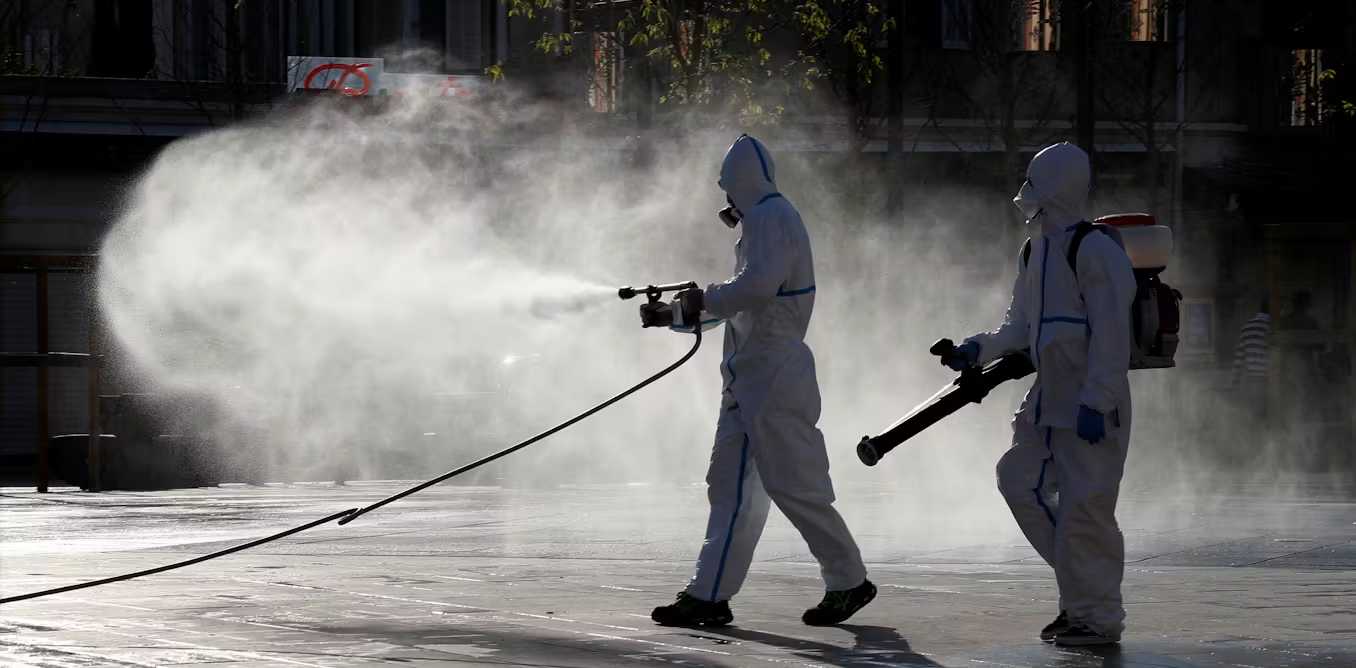
If you look at the date of my departure you might see what was to come. After finishing a particularly arduous day of wrestling with a piece of software (that I maintain a deep, deep hatred for), one of the regulars at the cafe a few doors down from my apartment told me about some new kind of flu that’s appeared in China. A wine glass spilling around in one hand I confidently deliver one of my poorest predictions “Ah these things pop up in China all the time, it’s fine, no need to worry about it”.
Lesson — Black-swan events exist
Take-away: The improbable eventually happens.
AT SOMETHING TO EXPRESS A BIT OF SENSITIVITY TO WHAT HAPPENED. With the news of COVID becoming increasingly concerning I once again revisited my interest in trading, fuelled in part by my discovery of the colourful forum /r/WallStreetBets (you may remember this name from the Gamestop short squeeze drama). Whilst on a Discord chat with fellow users I installed the epidemic modelling software GLEAMviz and put in the current numbers describing COVID transmission and mortality and it spit out chilling results: billions will be infected and millions will die. I called my parents to tell them how serious this was, and at the same time I bought lots of SPY put warrants (European-style options) and proceeded to make a 300% profit within a week. I did this a second time, and then the hot hand fallacy bit me and I did it a third time.
Lesson — Black swan events can also be exploited.
Take-away: The improbable eventually happens.
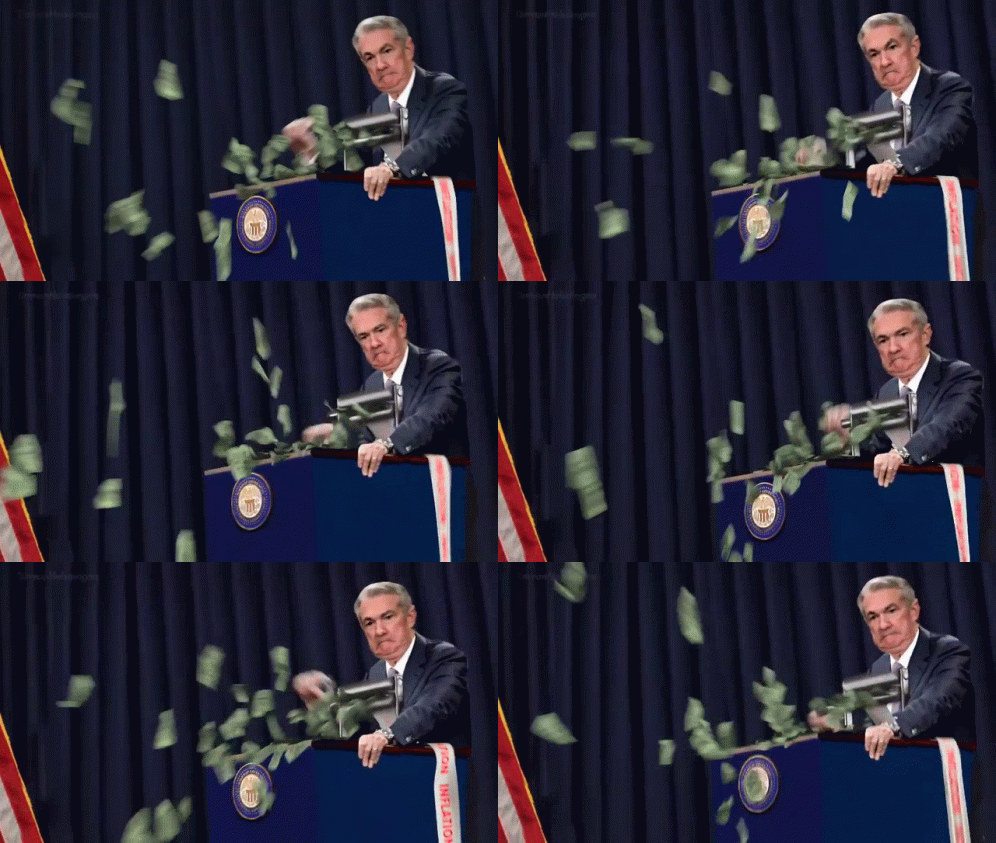
A day after my unfortunate decision Jerome Powell, the then and current head of the US Federal Reserve, began the largest quantitative easing programme ever seen; money was pouring back into US markets and SPY began a long, astonishing rebound. Once again my blood pressure went through the roof trying to win back my losses through frantic day trading and I called it quits after reaching break even.
These days my portfolio contains only growth stocks with only the occasional option - much less stressful.
Why finance?
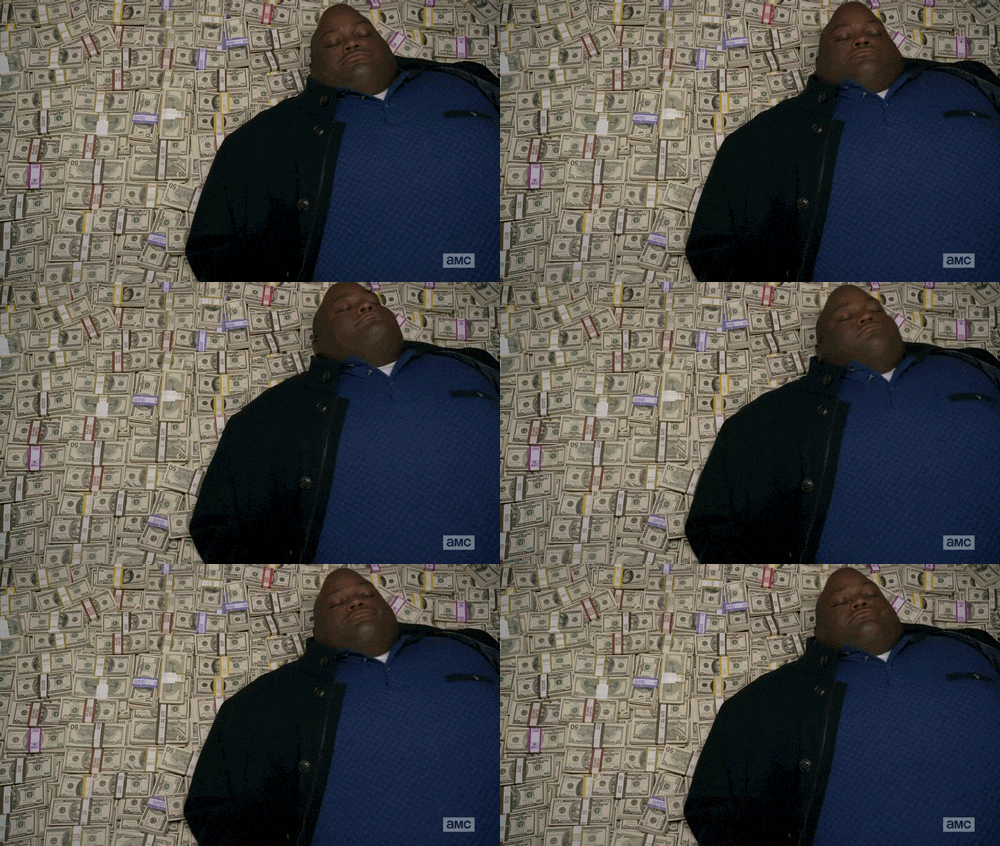
There’s no point beating around the bush, a large part of the motivation for going into finance is the good pay. Spending four years working fiendishly hard contributing to an incredibly promising technology and receiving little more than minimum wage is somewhat gruelling. I’ve spent the majority of my twenties living in shared student digs, two-thirds of my income going to rent and bills, unable to build savings, unable to help people friends and family out that were going through bad times - I want something more than this. But it is not all to do with money, finance is fascinating and I wouldn’t want to work in it if it weren’t!
Moving on from physics was not an easy decision. By and large, I loved the work. I loved to get to know some system or set of paradigms so well that I felt intertwined with them - my thoughts were clear and moved smoothly. With that I could probe deeper and produce work that I felt deeply proud of. For most of my life, I was not the best student, but it was adopting this principle at the beginning of the final year of my MPhys that changed everything for me: I decided that I was not going to produce work that I wasn’t proud of, no matter how long it took. I want to take this attitude, and competitiveness to a higher level - to the industry famous for it.
Given this and my existing interest in finance, it started to become a no-brainer what the next chapter in my life should be.
The project plan
I began the process of quant job hunting with a naive level of confidence. I carefully drafted a CV and cover letter, sent it to friends and family to proofread, and happily sent it off to one of the top-tier firms, feeling pretty certain that at the very least I’d get an interview. This was not the case. After thrashing around tinkering with my CV and sending out more applications with equal success I changed strategy. I searched for insight. On LinkedIn, I saw someone I recognised from my undergrad who happens to have the job title I am looking for, so I reached out for advice and was generously given a lot of his time. The main take-home was this: “Clearly you’re not an idiot if you’ve got a PhD in Physics, but how is a potential employer going to know that you’re any good at quantitative finance”. So to complement my applications I’ve decided to do quantitative finance myself and find some way to show off what I’ve been up to - this is the answer to the starting question of why I’m making a blog.
Content you’ll find
- Signal studies — discovering and stress-testing features that forecast returns.
- Strategy builds — iterative back-tests (walk-forward, out-of-sample) aiming for ever-better risk-adjusted metrics.
- Quant news — digestible takes on fresh research, especially ML methods.
- Dev logs — tooling, dataset plumbing, workflow tweaks.
Disclaimer: Educational content only — not investment advice.